Open the Prescription Window
Air drawn across the engine picks up heat, lowering the discharge's relative humidity and drying fuel — so you can start earlier in the day.
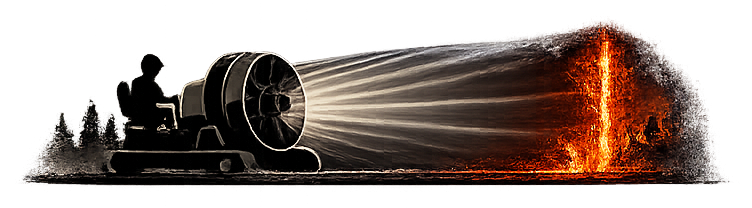
Prescribed Burns and Land Management
The only fire tool that works for you, not against you.
Every other fire tool exists to stop fire. On a prescribed burn you need the opposite — fire that lights sooner, moves faster, and finishes clean. FIREBREAK's engine-heated, directed airflow dries fuel, drives the flame front, and completes the burn, so you treat more ground on more days — without water, without chemicals, and without cutting a single dozer line.

The Problem
A prescribed burn lives inside a narrow prescription: relative humidity roughly 30 to 55 percent, steady wind 4 to 15 mph (not below 3), the right crew, and a day that cooperates.
Miss it and the acres roll to next season — or a marginal call becomes an escape. The constraint isn't willingness. It's conditions and confidence.
Nationwide, more than 230 million acres are overdue for prescribed fire.
What It Does
Reframed for making fire, not stopping it — directed airflow supports every phase of the burn.
Air drawn across the engine picks up heat, lowering the discharge's relative humidity and drying fuel — so you can start earlier in the day.
Propagate a head-fire rate of spread on command — even in calm air or when the natural wind opposes you.
Push piles and slash to full consumption, so there's no holdover left to reignite weeks later.
Direct airflow instead of churning firebreaks with dozers and hand tools.
Redirect ember wash back inside the burn to cut spot-fire potential across the line.
Sweep smoke and heat off personnel for safer, more efficient work.
Why It's Different
The safest burn is a backing fire, moving against the wind. The fastest is a head fire, moving with it. Burn bosses have always had to choose.
With FIREBREAK, the machine supplies the driving wind — so the fire advances at a head-fire rate while the natural wind still works against it as a built-in safety factor. Position flanking and frontal units and you choreograph the burn's direction and speed in real time, answering a natural wind shift in seconds.
Head-fire speed. Backing-fire safety. For the first time, you don't have to choose.
The Liability You Can Close
In 2022, a holdover from an incomplete pile burn became the largest wildfire in New Mexico history — and triggered a 90-day federal moratorium and stricter burn prescriptions.
Incomplete combustion is a liability that can smolder for months. FIREBREAK's airflow drives piles and slash to complete consumption — so you close the holdover risk before you leave the unit, and operate cleanly inside today's tighter rules.
Close the risk before you leave the unit.
Complete pile and slash consumption means no smoldering holdover waiting weeks to reignite — and a cleaner record under tighter prescriptions.
No Footprint
A mechanical firebreak protects the burn by damaging part of the land: churned soil, severed roots, disturbed watersheds and archaeological sites, and runoff that can carry contamination.
FIREBREAK gives you directional control with none of that footprint. On watersheds, pasture, farmland, and sensitive ground, that can be the difference between a burn you're allowed to run and one you aren't.
Directional control, zero soil disruption — on the ground that's hardest to get permitted.
Proven Output
*About 6× faster flame-front propagation vs. the adjacent control burn in field demonstration, at only 55% output. Engine-heated air lowers relative humidity on demand to open the window earlier; field time is limited only by fuel, not water resupply. Full specifications live on the Technology page.
Who It's Built For
Private burn contractors and prescribed fire managers — more burn days, fewer crew on the line.
Fuel reduction, habitat and ecosystem restoration at scale.
Ranches, timber, plantations, hunting preserves, and utilities managing rights-of-way.
Why It Matters
Open the window earlier and burn in conditions that once shut you down.
Head-fire propagation treats more hazardous fuel per operation.
Built-in safety factor and complete pile consumption.
No churning, no chemicals — land stays restorable and permittable.
Fewer people on the line, with smoke and heat swept clear.
Below mechanical treatment, with no water logistics.
The Difference
Every other fire tool reacts to fire. This one writes it.
You're not fighting the wind. You brought your own.
Frequently Asked
The prescription window is the range of conditions — humidity, wind, fuel moisture — in which a burn can be conducted safely. Air drawn across FIREBREAK's engine picks up heat, lowering the discharge's relative humidity and drying fuel at the flame front, so crews can start earlier in the day and burn in conditions that would otherwise be marginal — effectively widening the window.
The safest burn is a backing fire (against the wind); the fastest is a head fire (with it). FIREBREAK supplies the driving wind, so the fire advances at a head-fire rate while the natural wind still works against it as a built-in safety factor. In field demonstration a flame front advanced nearly six times faster than the adjacent control burn at only 55% output — under unfavorable conditions.
Yes. FIREBREAK drives piles and slash to complete consumption. Incomplete combustion is a known ignition source — in 2022 a holdover from an incomplete pile burn became the largest wildfire in New Mexico history. Finishing the burn closes that holdover risk before you leave the unit.
No. FIREBREAK uses only air, so there is no soil disruption and no chemical retardant. That protects soil, watersheds, farmland, pasture, and archaeological sites — often the difference between a burn you're permitted to run and one you aren't.
No. FIREBREAK is a tool that augments established prescribed-fire practice. Crews and burn plans remain in command; FIREBREAK gives them real-time control over the burn's direction, speed, and completion.
Burn bosses and private burn contractors; forestry, conservation, and land-trust organizations; and large landowners — ranches, timber, plantations, hunting preserves, and utilities managing rights-of-way.
Request a burn-day demonstration and see how machine-directed airflow can strengthen your prescribed fire program.
Request a Burn-Day Demonstration