Redirect Heat, Smoke & Flames
Move flame, heat, and smoke away from structures, equipment, and personnel for point protection.
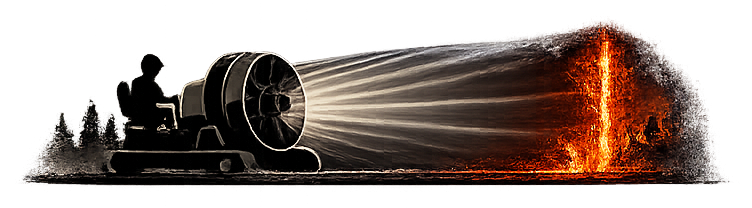
The World's First Machine-Directed Airflow System
Control the force that drives wildfire.
For the first time, fire crews can fight wind with wind — applying controlled, high-volume airflow to redirect heat, smoke, and flames, protect what matters, and create critical time when traditional methods reach their limits.

A New Operational Capability
Wildfire operations are dictated by one uncontrollable force: wind. It accelerates spread, intensifies flame, and transports embers that overwhelm containment.
FIREBREAK changes that equation. By generating powerful, directed airflow, crews gain a tool to influence fire behavior — not just react to it. It doesn't replace your engines, your water, or your people. It augments them, adding a layer of control that has never existed in the field.
Rather than adapting to nature, FIREBREAK lets crews shape the conditions that decide the outcome.
What It Does
Controlled airflow, applied with precision, opens up actions that were never possible before.
Move flame, heat, and smoke away from structures, equipment, and personnel for point protection.
Propagate or impede the flame front on demand — supporting prescribed burns, back burns, and blacklining.
Defend high-value assets — utilities, tanks, facilities — during rapidly evolving incidents.
Sweep heat and smoke off the line, creating safer, more workable conditions near the fire.
Help reduce ember-driven spot fire potential beyond the established line.
Buy minutes for suppression, evacuation, and containment as conditions worsen.
Proven Output
*In field testing, the flame front propagated nearly 6× faster than the adjacent control burn — at only 55% of maximum output. Sustained 337,523 CFM at 4,500 RPM.
Who It's Built For
Give wildland agencies and incident teams a new tool to support containment, protect infrastructure, and create operational time.
Explore Wildfires →Open the prescription window, burn safer and more completely, and reduce the risk of escape.
Explore Prescribed Burns →Protect people, infrastructure, and operations — keep an on-site unit ready when every minute counts.
Explore Private Industry →The Key Advantage Is Control
Air Control>Fire Control
For generations, wildfire operations have been forced to adapt to natural wind. FIREBREAK introduces the ability to apply controlled airflow where and when it's needed — turning the firefighter's oldest adversary into a tactical asset.
The Technology — M-DAS
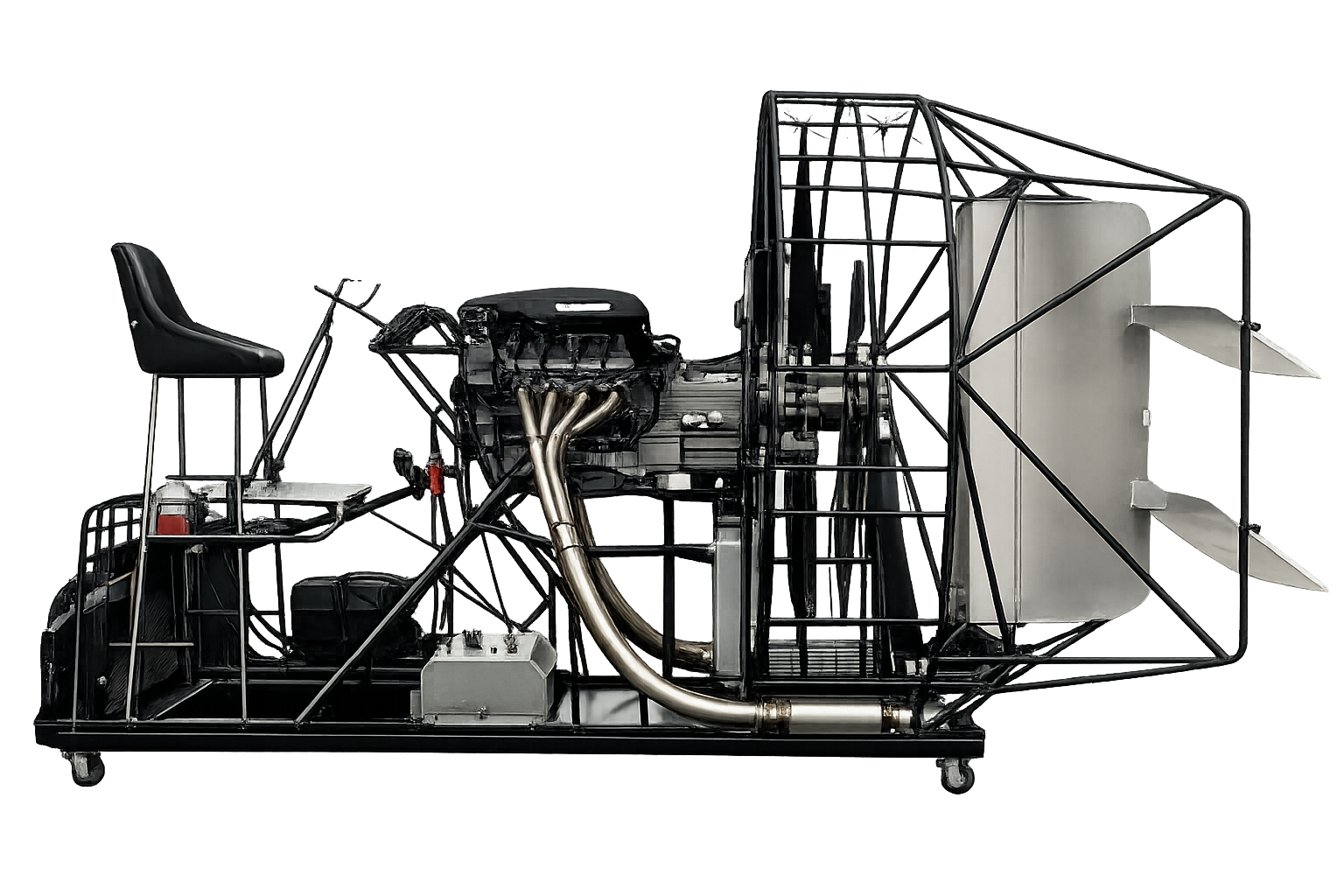
FIREBREAK is built on the patented Machine-Directed Air Stream System (M-DAS) — a mobile, high-volume airflow platform that uses only the infinite supply of clean air. No water. No chemical suppressants. No soil disruption.
It deploys fast, runs on engine fuel alone for long field stay-times, and transports on any vehicle with a lifting fork.
U.S. Patents 11,446,687 · 11,980,784
Why It Matters
Every minute of uncontrolled fire raises the cost — in damage, in liability, in lives. Control changes the math.
Time to bring resources to bear before fire overwhelms the response.
Time for people to move clear of the path of an advancing front.
Time to strengthen lines and hold defensive positions.
Time — and survivable corridors — when conditions turn against the crew.
Frequently Asked
FIREBREAK is the world's first machine-directed airflow system for fire operations. It applies controlled, high-volume airflow to influence fire behavior — redirecting heat, smoke and flames, supporting containment, protecting people and infrastructure, and creating critical time when traditional methods reach their limits.
FIREBREAK is built on the patented Machine-Directed Air Stream System (M-DAS). It generates targeted, high-velocity airflow — up to 156 mph and 337,523 CFM — to propagate or impede a flame front on demand, using only the infinite supply of air. Engine heat also lowers the discharge's humidity, helping dry fuel during prescribed burns.
No. FIREBREAK augments existing crews, engines, water, and aerial assets by adding a new layer of control. It is designed to work alongside established suppression and containment operations — not replace them.
No. FIREBREAK uses only air — the infinite, non-polluting resource. That means no dependence on water supply or expensive, hazardous chemical retardants, and field stay-times limited only by engine fuel. It also causes no soil disruption.
FIREBREAK supports wildfire response, prescribed burns and back burns, and the protection of private industry and critical infrastructure such as utilities, refineries, LNG terminals, and manufacturing facilities. It can also help complete pile and slash burns and create survivable escape corridors.
FIREBREAK is operational almost immediately upon offloading. It can be transported by any vehicle that can accommodate a lifting fork, so existing fleet equipment can move it.
FIREBREAK is modular and can be mounted on equipment you already own—such as tractors, skid steers, loaders, or other compatible vehicles—eliminating the need for a dedicated transport platform.
Yes. FIREBREAK is protected under U.S. Patent Nos. 11,446,687 and 11,980,784. In field testing it propagated a flame front nearly six times faster than an adjacent control burn while running at only 55% of maximum output — under conditions that were less than ideal.
Yes. FIREBREAK is engineered and built in the United States and powered by Panther Airboats.
Hold the Line
Request a demonstration and see how machine-directed airflow can strengthen your operations.
Request a Demo